
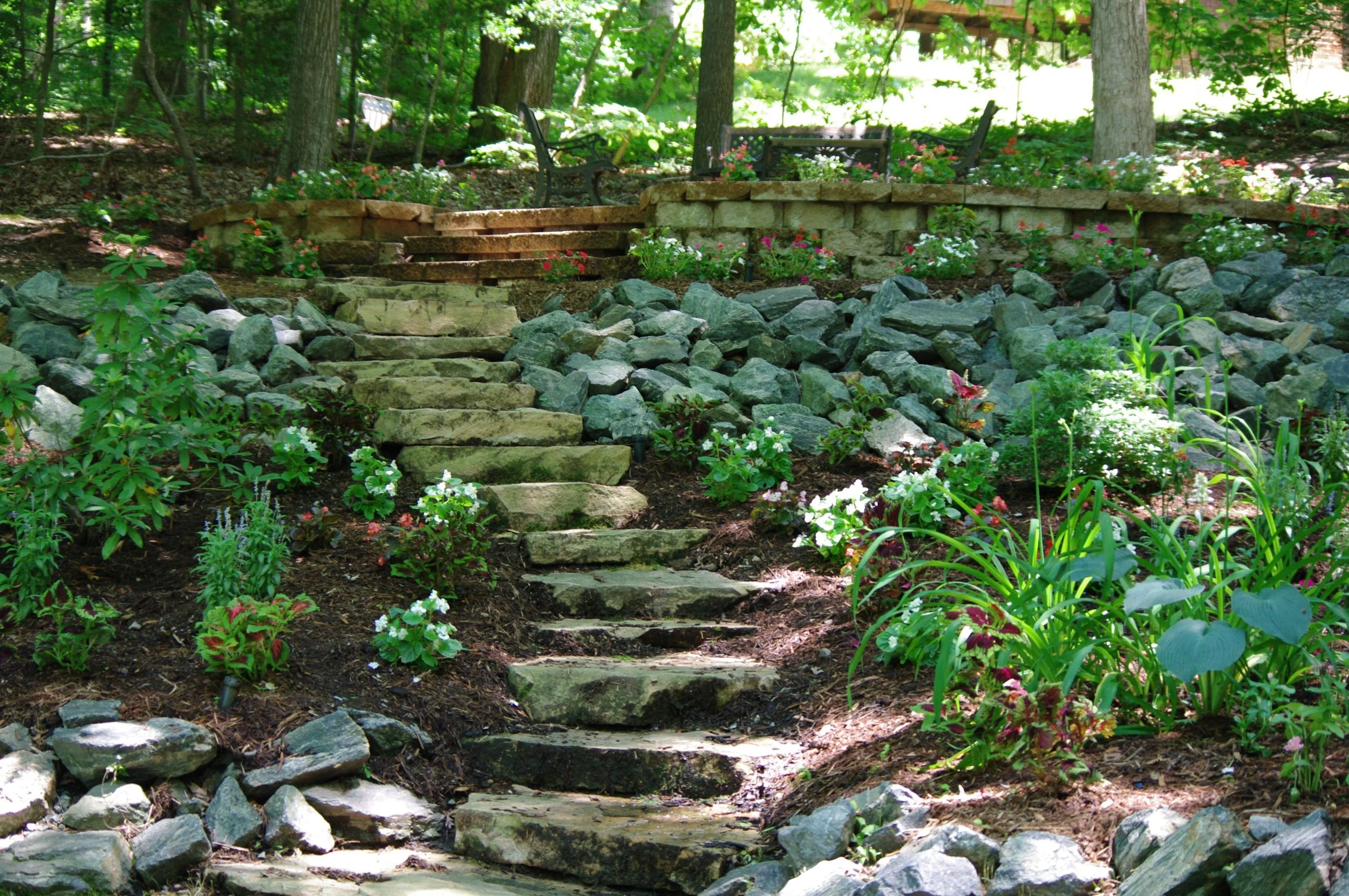
Slope decides more about a wall than the stone on the front of it does, which is awkward, because the stone is the part homeowners choose and the slope is the part a retaining wall contractor in Williamsburg, VA has to solve.
A wall is a structure holding back soil and the water moving through that soil, and everything visible is cladding on that argument.
HomeTurf has served Coastal Virginia since 2003, with over 80 years of combined experience across our team and locations in Williamsburg and Tappahannock.
Plenty of the outdoor spaces we build sit on ground that had to be held in place first, and these are the questions that decide if a wall is still straight in fifteen years.
What Is Actually Holding a Retaining Wall Up?
The base and the backfill hold a retaining wall up, not the facing.
A compacted aggregate base set below frost depth, a drainage layer of clean stone behind the block or stone, a perforated pipe running to a daylight outlet, and geogrid tied back into the slope on anything of height do the structural work.
Those four items are most of the cost, and none of them appear in a photograph. A quote that itemizes facing material and little else is describing a veneer rather than a structure.
At What Height Does a Retaining Wall Need Engineering?
A retaining wall needs engineering at a lower height than most people assume, and the local threshold is worth confirming before design rather than during permitting. Height is not the only trigger either.
A wall carrying a driveway, a pool deck, a structure, or a steep slope above it is taking a surcharge load.
A four-foot wall under a driveway is often a larger engineering problem than a six-foot wall holding a lawn, and settling that question early keeps it out of the middle of a build.
Where Does the Water Go Behind a Retaining Wall?
Water behind a retaining wall has to move through the wall, around it, and away from the house, and every one of those paths has to be drawn.
Hydrostatic pressure behind a wall with no outlet is the single most common reason walls lean, bulge, and fail in this part of Virginia.
The drain line needs a place to discharge that is lower than the pipe and somewhere that does not create a new problem in a neighbor’s yard. Ask to be shown the discharge point on the ground, not on a drawing.
Related: Strength, Structure, and Style: The Lasting Value of a Professionally Built Retaining Wall
How Does Tidewater Soil Change a Retaining Wall Build?
Tidewater’s sandy and silty soils drain quickly and hold less than clay, which sounds helpful and complicates compaction.
Material that is easy to excavate is also easy to undermine, so the base preparation and the drainage outlet take on more weight.
Any contractor who has built in this area should be able to say what they expect to find once the first cut is open, and what changes if the soil is different.
An allowance for that in the quote is a sign of someone who has opened ground here before.
What Should Appear on a Retaining Wall Quote?
A retaining wall quote should show excavation depth, base material and thickness, drainage stone and pipe, reinforcement where it applies, and the plan for where the water discharges.
A line that reads simply as a price per square foot of face hides every decision that determines if the wall lasts.
The comparable quotes are the ones that show their excavation and drainage. Our process runs through Discover and Design, Approve and Plan, Build and Transform, and a Final Walkthrough, so those decisions are settled and approved before the first cut.
Have a Retaining Wall Contractor in Williamsburg Look at the Grade First
The useful first conversation happens standing on the slope, looking at where water currently runs and what sits above the wall line. The material choice comes after the structure is settled.
HomeTurf builds retaining walls, seating walls, and the hardscape around them for properties across Williamsburg, James City County, New Kent County, Poquoson, Hampton, and the surrounding Coastal Virginia communities.
Schedule your retaining wall consultation with HomeTurf.
In Summary
Can an existing wall that is leaning be repaired?
A leaning wall is sometimes repaired by resetting the top courses, though a lean usually signals a drainage or base problem underneath. Rebuilding the failed section properly tends to cost less than resetting the same wall twice.
How long does a retaining wall take to build?
A modest garden wall commonly takes a few days on site. Anything requiring engineering, significant excavation, or a long drainage run takes noticeably longer, and weather on open ground is the usual variable.
Do terraced walls work better than one tall wall?
On steeper Williamsburg grades, terraced walls frequently outperform one tall wall, which is why HomeTurf looks at the full slope before settling on a wall design. Two shorter walls with a planted bench between them reduce the load on each and often avoid the engineering threshold a single tall wall would cross.
Related: How a Patio Becomes the Room the Family Uses Most From April Through November in Williamsburg, VA
